
The TVS Ronin and Royal Enfield Hunter 350 are two motorcycles that often end up on the same shortlist, even though they arrive at the 350cc-class from very different directions. The Ronin uses a smaller 225.9cc oil-cooled engine and focuses on a lighter, more feature-heavy package. The Hunter 350 uses Royal Enfield’s familiar 349cc J-series engine and leans on the brand’s retro-roadster identity.
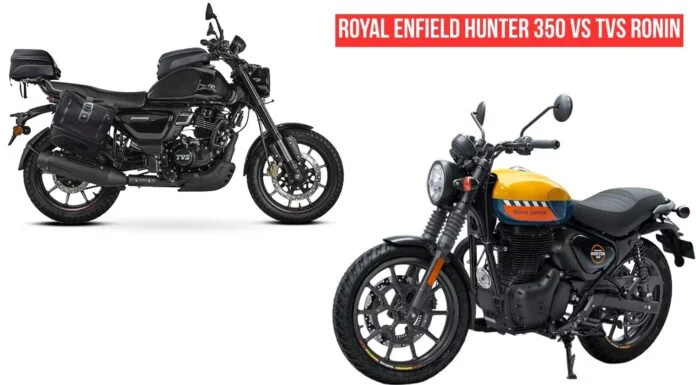
Both received updates for 2026. TVS added a new Base+ variant to the Ronin range and introduced connected features on higher trims, while Royal Enfield added a Base Premium variant to the Hunter 350 line-up along with new colour options on the top variant. This comparison looks at what those changes mean for a buyer in India.
TVS Ronin vs Royal Enfield Hunter 350: Quick Comparison
Note: Specifications vary by variant. The table above uses the top variant for each motorcycle where applicable. Always confirm the exact specification for the variant you are considering.
Price: Ex-Showroom vs On-Road
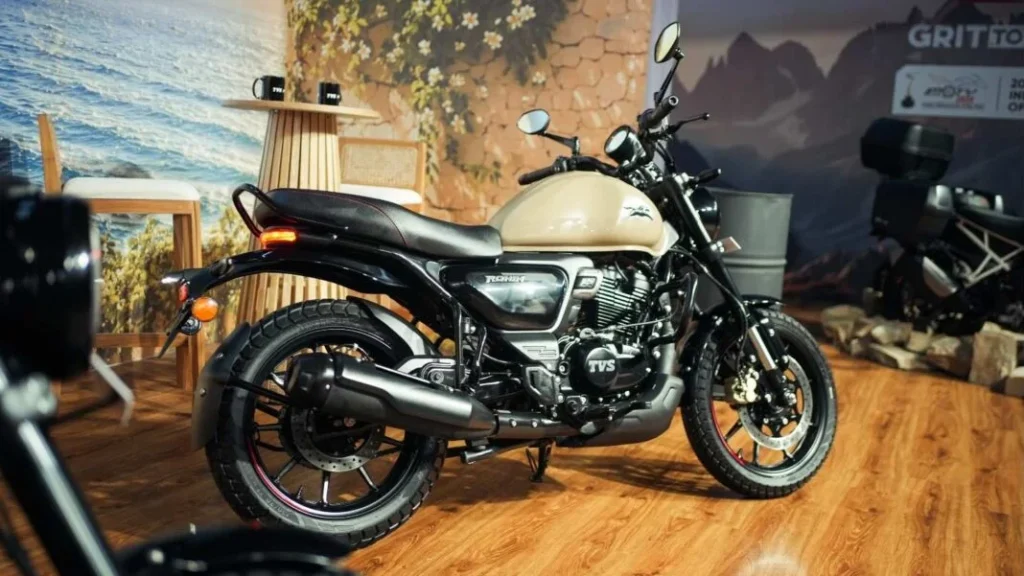
Prices for both motorcycles are best understood in two parts: the ex-showroom price, which is what the manufacturer advertises, and the on-road price, which includes RTO registration, road tax, insurance and any dealer-level charges. Ex-showroom prices can be similar across cities, while on-road prices differ because registration and insurance costs vary by state and city.
TVS Ronin (ex-showroom, Delhi, as of September 2026):
- Base: ₹1,30,290
- Base+: ₹1,42,490 (new variant with dual-channel ABS)
- Mid: ₹1,51,540 (now with connected cluster and Type-C charger)
- Top: ₹1,63,640 (now with traction control and a premium seat)
Royal Enfield Hunter 350 (ex-showroom, Chennai, as of April 2026):
- Base (Retro): ₹1,37,640
- Base Premium: ₹1,49,900 (new variant with alloy wheels, tubeless tyres, stitched seat and slip-and-assist clutch)
- Mid variants: ₹1,62,292 approx.
- Top (with new Mumbai Yellow and Moonshot White colours): ₹1,69,804
On-road prices in Delhi, for reference, start at approximately ₹1.52 lakh for the Ronin base and ₹1.60 lakh for the Hunter 350 base. These figures include RTO charges and insurance, and will vary if you buy in another state or choose a different variant. If you are buying in Uttar Pradesh, Haryana, Punjab, Tamil Nadu, Bihar, Jharkhand, Madhya Pradesh, Rajasthan or Gujarat, confirm the on-road price with a local authorised dealer, because road tax and registration charges differ by state.
What this means for a buyer: The Ronin’s entry point is lower, but the Hunter 350’s Base Premium variant adds alloy wheels and tubeless tyres at a price that sits between the Ronin’s Base+ and Mid trims. If your budget is tight, the Ronin gives you more options at the lower end. If you want the Royal Enfield brand and a 349cc engine, the Hunter 350 Base Premium is the most accessible way into that experience with practical upgrades over the base Retro trim.
Engine and Performance
The two engines are not direct competitors in displacement terms. The Ronin’s 225.9cc engine is smaller, but it produces nearly the same peak power as the Hunter’s 349cc unit. Where they differ is in how that power is delivered.
TVS Ronin: The 225.9cc oil-cooled engine makes 20.4 PS at 7,750 rpm and 19.93 Nm of torque at 3,750 rpm. Peak torque arrives low in the rev range, which means the Ronin pulls cleanly from low speeds without needing to be revved hard. The 5-speed gearbox is paired with an assist and slipper clutch, which reduces lever effort and helps prevent rear-wheel hop during aggressive downshifts.
Royal Enfield Hunter 350: The 349cc air-oil cooled J-series engine produces 20.2 bhp at 6,100 rpm and 27 Nm of torque at 4,000 rpm. The torque figure is significantly higher than the Ronin’s, and it peaks at a very accessible 4,000 rpm. That torque is the Hunter’s defining characteristic: it delivers strong, effortless pull in the lower gears, which is useful in stop-and-go traffic and for overtaking without downshifting.
What this means for everyday riding: In city traffic, both motorcycles are easy to manage at low speeds. The Ronin’s lighter weight makes it feel more agile when weaving through traffic or parking. The Hunter’s extra torque means you can stay in a higher gear at low speeds and still accelerate cleanly when the road opens up. On the highway, the Ronin can hold 80–90 kmph comfortably, but the Hunter’s additional torque makes highway overtakes less effortful, especially with a pillion or luggage.
Neither engine is designed for high-speed cruising. If your regular riding involves long stretches of expressway at 100 kmph or more, both motorcycles will feel like they are working hard. For city commuting and weekend rides on state highways, both are adequate.
Design, Dimensions and Riding Position
The Ronin and Hunter 350 look and feel very different from the saddle.
The Ronin has a kerb weight of approximately 160 kg and a seat height of 795 mm. The Hunter 350 weighs 181 kg and has a seat height of 790 mm. The 21 kg difference is noticeable when pushing the bike around or parking. The Ronin’s lighter weight makes it easier to manage for shorter riders or those who are not confident with heavier motorcycles. The Hunter’s weight is not excessive for a 350cc motorcycle, but it is a factor in low-speed manoeuvring.
Ground clearance favours the Ronin at 181 mm against the Hunter’s 160 mm. Higher ground clearance is useful on broken roads, speed breakers and unpaved sections. If you regularly ride on roads with poor surfaces, the Ronin’s additional clearance is a practical advantage.
The Ronin’s front suspension is a 41mm upside-down fork, which is a more modern design than the Hunter’s telescopic fork. USD forks are generally stiffer and can offer better front-end feel, though the real-world difference depends on how each motorcycle is tuned. The Ronin’s rear monoshock has 7-step adjustable preload; the Hunter’s twin shocks have 6-step adjustable preload. Both allow you to adjust rear suspension for a pillion or luggage.
The Ronin’s 14-litre tank against the Hunter’s 13-litre tank is a minor difference. Combined with the Ronin’s higher claimed fuel efficiency, the Ronin should offer a longer range between fuel stops, which matters if you ride long distances or want to minimise fuel stops.
Features: What You Actually Get
Features are only useful if they do something for the rider. Here is what the key features on each motorcycle actually do.
TVS Ronin:
- Traction control (Top variant): Traction control reduces the chance of the rear wheel losing grip under acceleration, particularly on wet or loose surfaces. It is a safety aid that can be useful in the rain or on gravel, though it does not replace careful throttle control.
- SmartXonnect connectivity (Mid and Top variants): This pairs the instrument cluster with a smartphone via Bluetooth. It enables turn-by-turn navigation, call and SMS alerts, and voice assistance for navigation and bike health updates. Navigation on the cluster means you do not need to mount your phone on the handlebar.
- Type-C charger (Mid and Top variants): Charges a phone while riding. A Type-C port is more convenient than older USB-A ports because it is reversible and supports faster charging on compatible devices.
- LED lighting: The Ronin uses all-LED lighting, including the headlight. LED headlights typically provide better illumination than halogen units and use less power.
- Glide Through Technology: This allows the motorcycle to move at very low speeds in traffic using only clutch modulation, without needing throttle input. It is designed to make heavy traffic less tiring.
Royal Enfield Hunter 350:
- Tripper navigation pod: The Hunter 350’s digi-analogue instrument cluster includes Royal Enfield’s Tripper navigation system, which pairs with a smartphone via Bluetooth to provide turn-by-turn directions. This is a simpler system than TVS’s SmartXonnect but covers the core navigation function.
- USB charging port: The Hunter 350 has a USB port for charging devices. The Base and Base Premium variants have a slower charger than the higher variants.
- Dual-channel ABS (top variants): Dual-channel ABS monitors both wheels, which can help maintain stability under hard braking. Single-channel ABS only monitors the front wheel. The base and Base Premium variants use single-channel ABS.
- Alloy wheels with tubeless tyres (Base Premium and above): Tubeless tyres can be repaired more easily after a puncture, and they deflate more gradually than tube-type tyres if punctured. Alloy wheels also require less maintenance than spoke wheels.
What this means for a buyer: The Ronin offers a more feature-dense package at the top end, particularly with traction control and integrated navigation. The Hunter 350’s feature set is more focused on the essentials, with navigation and USB charging. If you want the most technology for your money, the Ronin’s Top variant delivers more. If you prefer a simpler motorcycle with navigation and charging, the Hunter 350 covers the basics.
Ride and Practicality: City, Highway and Everyday Use
City riding: The Ronin’s lighter weight and lower-effort clutch make it easier to manage in dense traffic. The Glide Through Technology is genuinely useful in stop-and-go conditions because it reduces the need to constantly work the throttle and clutch. The Hunter 350 is not difficult in traffic, but its extra weight and longer gearing mean you will use the clutch more at very low speeds. Both motorcycles have a comfortable upright riding position, though the Ronin’s handlebar and seat position are slightly more relaxed.
Highway riding: The Hunter 350’s additional torque makes highway riding less demanding. You can hold a higher gear at 80–90 kmph and still have enough pull to overtake. The Ronin can also cruise at similar speeds, but you will need to work the gearbox more for overtakes. Neither motorcycle is ideal for sustained high-speed touring, but the Hunter is the more relaxed choice for highway stretches.
Pillion comfort: The Ronin’s flatter seat and slightly lower seat height may make it easier for a pillion to mount and dismount. The Hunter’s seat is also reasonably flat, but the motorcycle’s higher weight and slightly taller seat height could matter for shorter pillions. Both motorcycles have grab rails.
Parking and low-speed handling: The Ronin’s lighter weight is a clear advantage when parking or pushing the bike in tight spaces. The Hunter’s additional 21 kg is noticeable when manoeuvring at walking pace.
Fuel efficiency: TVS claims an ARAI-certified mileage of around 42 kmpl for the Ronin, while Royal Enfield claims 36.2 kmpl for the Hunter 350. These are laboratory figures and real-world mileage will be lower. Expect the Ronin to return somewhere in the mid-to-high 30s in mixed riding, and the Hunter 350 in the low-to-mid 30s. Actual fuel efficiency depends on traffic, riding style, speed, load, tyre pressure and maintenance. The Ronin’s larger tank and higher claimed efficiency give it a longer theoretical range.
Which One Fits Your Requirements?
There is no single answer that works for every buyer. The right choice depends on what you value most.
A buyer prioritising lower weight and easier city handling may find the TVS Ronin more manageable. Its 160 kg kerb weight and Glide Through Technology are designed for exactly this kind of use.
A buyer who wants the most features for the money may want to look closely at the Ronin’s Mid and Top variants. Connected navigation, traction control and a Type-C charger are included at prices that undercut the Hunter 350’s equivalent trims.
A buyer who values engine character and torque may prefer the Hunter 350. The 349cc J-series engine’s 27 Nm of torque at 4,000 rpm gives it a relaxed, effortless feel that the Ronin’s smaller engine cannot match.
A buyer who wants the Royal Enfield brand and a retro-roadster look will naturally gravitate towards the Hunter 350. The design, the sound and the brand identity are part of the appeal.
A shorter rider or someone stepping up from a smaller motorcycle may find the Ronin easier to handle. Its lower weight and slightly higher ground clearance make it less intimidating at low speeds.
Someone planning frequent highway trips may want to compare both motorcycles on a test ride. The Hunter’s torque advantage is useful on the highway, but the Ronin’s lighter weight and longer range could offset that for some riders.
A buyer on a tight budget will find the Ronin’s entry point lower. The Hunter 350’s Base Premium variant, however, offers alloy wheels and tubeless tyres at a price that sits close to the Ronin’s Mid variant, so the value calculation depends on which features matter to you.
Variants and What They Change
TVS Ronin:
- Base (₹1,30,290): Single-channel ABS, Rain and Urban riding modes, LED lighting, digital instrument cluster without connectivity.
- Base+ (₹1,42,490): Adds dual-channel ABS. Available in Sunlit Yellow and Desert Mirage colours.
- Mid (₹1,51,540): Adds Bluetooth connectivity with turn-by-turn navigation and a Type-C charger.
- Top (₹1,63,640): Adds traction control and a premium seat.
Royal Enfield Hunter 350:
- Base/Retro: Single-channel ABS, front disc and rear drum brake, spoke wheels, halogen headlight.
- Base Premium (₹1,49,900): Adds alloy wheels with tubeless tyres, a more powerful 54W halogen headlight, a stitched seat, a revised grab rail and a slip-and-assist clutch. Still single-channel ABS with a rear disc brake.
- Mid variants: Dual-channel ABS, rear disc brake, alloy wheels.
- Top variants (₹1,69,804 with new colours): Dual-channel ABS, Tripper navigation, and the option of Mumbai Yellow or Moonshot White colour schemes.
Both motorcycles have seen price changes through 2025 and 2026. Prices can change further, and offers or festive discounts may affect the final amount you pay. Confirm the latest price with an authorised dealer before making a decision.
Frequently Asked Questions
Is the TVS Ronin a 350cc motorcycle?
No. The Ronin uses a 225.9cc engine. It is often compared with 350cc motorcycles because its price and positioning overlap with them, but its engine displacement is smaller.
Does the Hunter 350 have traction control?
No. The Hunter 350 does not offer traction control on any variant. Traction control is available on the TVS Ronin’s Top variant.
Which motorcycle has better fuel efficiency?
TVS claims a higher ARAI-certified figure for the Ronin (around 42 kmpl) than Royal Enfield claims for the Hunter 350 (36.2 kmpl). Real-world figures will be lower for both, and the difference depends on how and where you ride.
Can I tour on either of these motorcycles?
Both can handle weekend trips and moderate highway distances. The Hunter 350’s extra torque makes highway riding less effortful, while the Ronin’s lighter weight and longer range may suit some riders better. Neither is designed for long-distance touring in the way a dedicated touring motorcycle would be.
Which one is better for a beginner?
The Ronin’s lighter weight and lower-effort clutch make it easier to manage for a new rider. The Hunter 350 is not difficult to ride, but its extra weight requires more confidence at low speeds.
Do both motorcycles have tubeless tyres?
The Ronin has tubeless tyres across all variants. On the Hunter 350, the base Retro variant uses spoke wheels with tube-type tyres; the Base Premium and higher variants use alloy wheels with tubeless tyres.
Are spare parts and service widely available?
TVS and Royal Enfield both have extensive dealer and service networks across India, including in Uttar Pradesh, Haryana, Punjab, Tamil Nadu, Bihar, Jharkhand, Madhya Pradesh, Rajasthan and Gujarat. Specific service experiences can vary by dealership. It is worth checking the nearest authorised service centre for both brands before you buy.